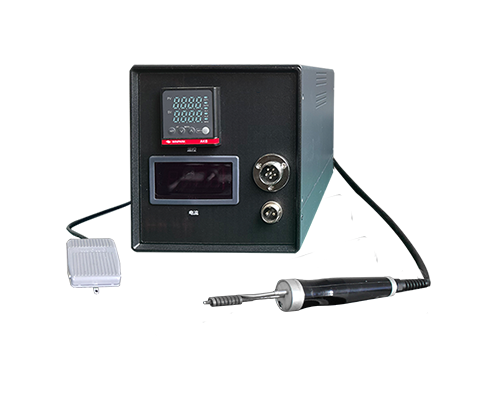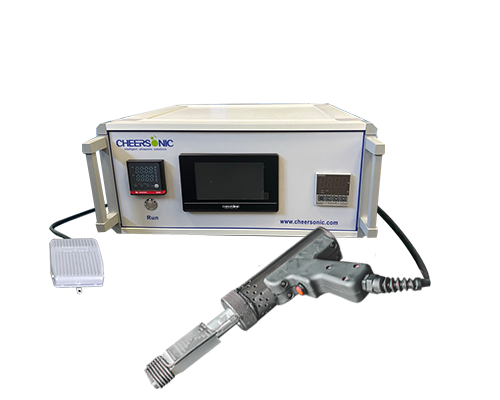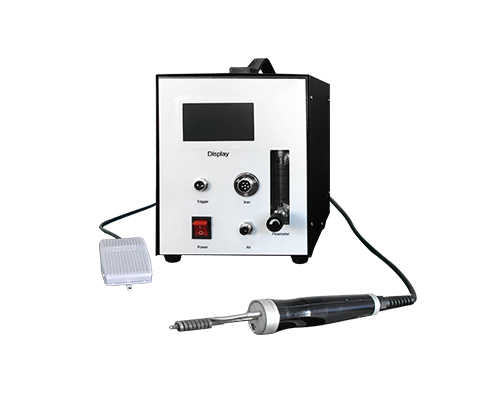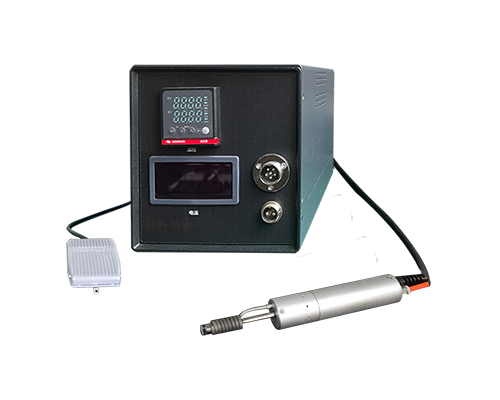
Against the backdrop of the rapid development of the electronics manufacturing industry towards miniaturization and high precision, flexible printed circuit boards (FPCs) are widely used in products such as smartphones, tablets, and wearable devices due to their advantages of being thin, flexible, and having high-density wiring. FPC soldering, as a key process in electronic assembly, places stringent requirements on soldering precision, efficiency, and reliability. Ultrasonic soldering machines, with their unique technological advantages, have become the ideal choice in this field.
The core working principle of an ultrasonic soldering machine is to use high-frequency vibration energy to achieve a metallurgical bond between the solder and the FPC pads. It converts electrical energy into high-frequency mechanical vibration through a transducer, which is amplified by an amplitude transformer and transmitted to the solder head, causing the solder to melt rapidly under the action of vibration energy and slight pressure. Compared with traditional hot air soldering and soldering iron soldering, ultrasonic soldering does not require high-temperature, prolonged heating; only a localized, instantaneous temperature rise is needed to complete the soldering, effectively avoiding problems such as FPC substrate deformation due to high temperatures and pad detachment, thus ensuring the structural integrity of the product.
In practical applications of FPC soldering, ultrasonic soldering machines demonstrate significant practical advantages. Firstly, ultrasonic soldering offers high welding precision. Its concentrated vibration energy targets tiny pads with a minimum welding spacing of 0.1mm, perfectly suited to the high-density wiring requirements of FPCs, effectively reducing defects such as bridging and cold solder joints. Secondly, it boasts outstanding welding efficiency, with a single welding cycle of only 0.5-2 seconds, enabling automated continuous operation and significantly increasing production line throughput, making it particularly suitable for mass production scenarios. Furthermore, ultrasonic welding produces weld joints with high strength, low resistance, and strong oxidation resistance, ensuring the connection stability of FPCs under complex working conditions and extending product lifespan.
Addressing the soft and easily damaged nature of FPC materials, ultrasonic soldering machines also feature a unique adaptive design. The welding pressure can be precisely adjusted, with a minimum pressure as low as 0.1N, avoiding mechanical damage to the FPC. Simultaneously, the welding temperature can be controlled within the 200-300℃ range, far lower than the high temperatures of traditional welding processes, reducing the impact of thermal stress on the FPC substrate and surrounding components. Whether it's single-sided or double-sided FPCs, multi-layer FPCs, or dissimilar material soldering of FPCs with connectors and chips, ultrasonic soldering machines provide stable and reliable soldering results.
As electronic terminal products upgrade towards thinner, lighter, and higher-performance designs, the application scenarios for FPCs will continue to expand, and the requirements for soldering technology will continue to increase. With its core advantages of high precision, high efficiency, and low damage, ultrasonic soldering machines are gradually replacing traditional soldering equipment and becoming the mainstream solution in the FPC soldering field. In the future, with continuous technological iteration, ultrasonic soldering machines will make further breakthroughs in intelligent control and multi-station integration, providing stronger support for the high-quality development of the electronics manufacturing industry.