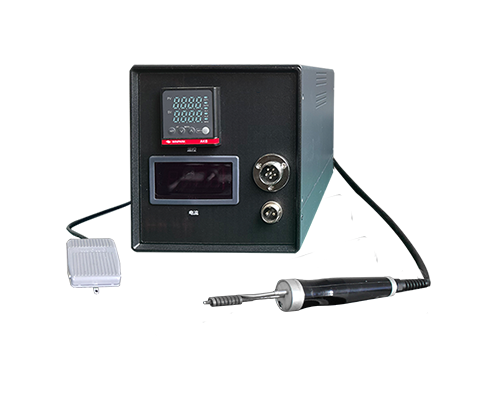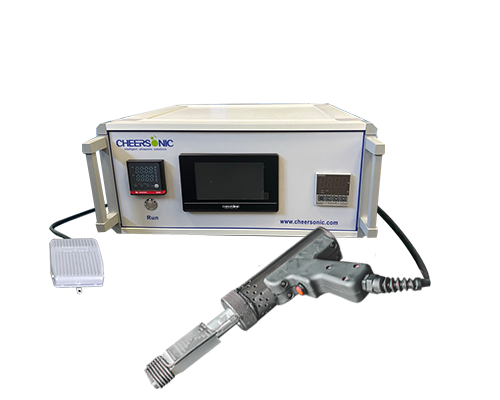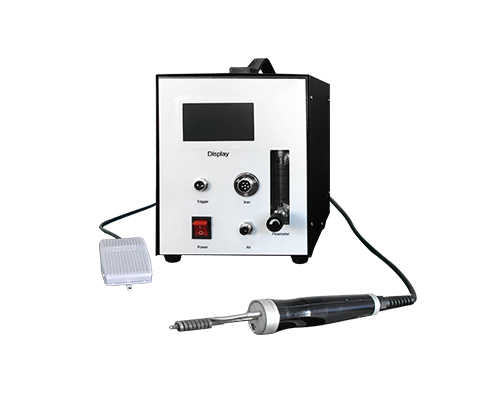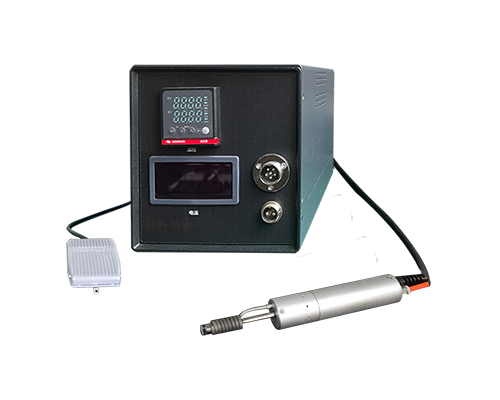
In the research and development and debugging of electronic devices, the functional verification and software debugging of MEMS sensor chips are crucial steps to ensure stable product performance. These chips, which are typically already packaged, need to be precisely connected to test circuit boards before subsequent performance testing and program debugging can be carried out. Ultrasonic soldering irons, with their unique technological advantages, have become the core tool for achieving this connection process.
Compared to traditional soldering irons, ultrasonic soldering irons exhibit significant advantages in soldering MEMS sensor chips. Traditional soldering irons rely on high-temperature heating to melt the solder. If the temperature is not properly controlled, it can easily damage the MEMS sensor chip due to high temperatures—the internal structure of these chips is delicate and extremely sensitive to temperature changes. Excessive temperatures may damage their internal circuitry or packaging structure, affecting the accuracy of subsequent test results. Ultrasonic soldering irons achieve soldering through a combination of high-frequency vibration energy and moderate temperature. This not only effectively reduces the overall temperature during the soldering process and minimizes the thermal shock to the chip, but also allows the solder to spread more evenly through vibration, improving the stability and conductivity of the solder joint. This fundamentally solves the potential damage problem to MEMS sensor chips caused by traditional soldering methods. In actual soldering operations, the application of ultrasonic soldering irons requires adherence to strict procedures and specifications to ensure soldering quality and testing results. First, the soldering area of the test circuit board must be cleaned to remove surface oxide layers and dust, preventing impurities from affecting solder joint contact performance. Then, based on the pin spacing and package specifications of the MEMS sensor chip, appropriate solder wire and soldering iron tip must be selected, ensuring the tip is precisely aligned with the soldering position. During soldering, the ultrasonic vibration frequency, heating temperature, and soldering time must be precisely controlled—excessive vibration frequency may deform chip pins, while insufficient temperature or time will result in cold solder joints. Only by adjusting all parameters to the appropriate range can a strong and highly conductive solder joint be formed. After soldering, the solder joint morphology must be observed under a microscope to check for any missing solder joints, cold solder joints, or solder overflow, ensuring that each solder joint meets testing requirements.

After successfully soldering the MEMS sensor chip to the test circuit board using an ultrasonic soldering iron, R&D personnel can smoothly carry out chip functional verification and software debugging. During the functional verification phase, control signals can be sent to the chip via a test circuit board to check whether the chip can accurately output the corresponding sensing data and determine whether its core functions are normal. In the software debugging phase, R&D personnel can optimize the driver program and data processing algorithms of the adapted chip based on the soldered circuit connections, resolving issues such as data deviation and response delay during software operation. The reliability of this soldering process directly determines the accuracy of subsequent testing and debugging results, laying a solid foundation for the performance optimization and product application of MEMS sensor chips.
With the widespread application of MEMS sensor technology in consumer electronics, industrial control, medical devices, and other fields, the requirements for testing efficiency and accuracy are constantly increasing. Ultrasonic soldering irons, with their friendly soldering characteristics for precision chips and stable soldering quality, have become an indispensable tool in the MEMS sensor chip testing process. They not only help R&D personnel complete testing and debugging work more efficiently but also provide strong support for promoting the continuous innovation and application of MEMS sensor technology.